


Where Are You Getting Your Potassium From?
By Dustin Strong CHN, ACN
For years, one of the loudest conversations in health has been about sodium.
“Too much salt.”
“Watch your sodium.”
“Low sodium everything.”
And while there may absolutely be situations where sodium intake deserves attention…
I often find myself asking a different question entirely:
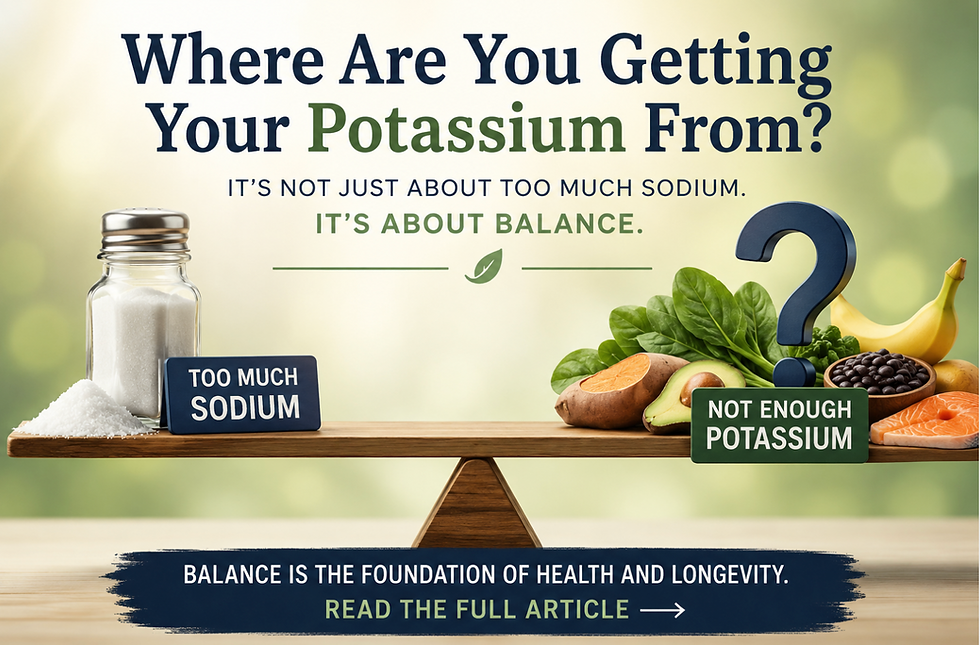
Where are you getting your potassium from?
Because sometimes the issue is not simply that sodium is too high.
Sometimes it is that potassium is too low.
And that changes the conversation completely.
The Forgotten Half of the Equation
Sodium and potassium exist in a remarkable balancing act inside the human body.
Sodium largely governs the fluid outside the cells.
Potassium largely governs the fluid inside the cells.
Together, they help regulate:
hydration
nerve communication
muscle contraction
heart rhythm
energy production
blood pressure
adrenal function
cellular electrical activity
In fact, one of the most energy-demanding processes in the human body is the sodium-potassium pump.
3Na out \ 2K in
Every heartbeat…
Every thought…
Every muscle contraction…
depends on this delicate mineral dance.
What Changed?
Historically, humans likely consumed diets naturally rich in potassium:
roots and tubers
leafy greens
beans
squash
fruit
fish
mineral-rich foods from the earth
At the same time, sodium intake tended to come from naturally occurring sources rather than heavily processed foods.
Modern diets often flip this pattern upside down.
Today many people consume:
high amounts of processed sodium
low amounts of potassium-rich foods
low magnesium
low mineral diversity overall
This creates a very different physiological environment.
And importantly:
The body does not experience minerals in isolation.
Why I Prefer Food First
When people ask me about “alkalizing” strategies or products like Kangen water, I often steer the conversation back toward food.
Because the body is already incredibly intelligent at regulating pH.
The lungs help regulate carbon dioxide.
The kidneys regulate bicarbonate and mineral balance.
Bones act as mineral reservoirs.
Proteins themselves function as buffers.
The question becomes less:“How do we force alkalinity into the body?”
And more:“How do we create an environment that the body thrives in naturally?”
That often starts with whole foods rich in potassium and their naturally occurring cofactors.
Foods like:
avocados
potatoes
sweet potatoes
leafy greens
black beans
squash
coconut water
sardines
salmon
These foods do not just provide potassium.
They provide context.
Magnesium.
Fiber.
Polyphenols.
Amino acids.
Trace minerals.
Healthy fats.
Natural ratios.
Nature rarely delivers nutrients one at a time.
An Essential Longevity Conversation
When we talk about longevity, heart health, brain health, hydration, stress resilience, energy, or healthy aging…
we should probably be asking more often:
Where are you getting your potassium from?
Because sometimes the body is not asking for restriction.
Sometimes it is asking for nourishment.
And that is a very different conversation.
Comments