


The Urgency of Brain Health: Why Omega-3 Status May Be One of the Most Important Metrics You’re Not Measuring
Updated: Mar 20
By Dustin Strong, CHN, ACN
We are entering a new era of medicine—one where brain health can no longer be treated as something we think about “later.”
Because the truth is this:
By the time symptoms appear, the process has already been unfolding for years—if not decades.
And now, emerging research is forcing us to take that reality much more seriously.
A Landmark Study: Omega-3 Status and Early-Onset Dementia
A newly published longitudinal study in Clinical Nutrition followed over 217,000 adults aged 40–64 for more than 8 years—making it one of the largest studies of its kind.
The finding was both simple and profound:
Higher blood levels of omega-3 fatty acids were associated with a significantly lower risk of early-onset dementia (before age 65).
In fact, individuals with the highest omega-3 levels showed approximately a 35–40% lower risk compared to those with the lowest levels.
Let’s pause on that.
This is not late-life cognitive decline.This is dementia affecting people in their 40s, 50s, and early 60s—often in the middle of careers, families, and peak life responsibility.
And importantly…
This study didn’t rely on food questionnaires.
It measured actual omega-3 levels in the blood—removing guesswork, bias, and misreporting.
Why This Changes the Conversation
For years, brain health conversations have centered around aging populations.
But this research highlights something deeper:
👉 Brain degeneration is not an event—it’s a trajectory.👉 And that trajectory begins in midlife (or earlier).
Even more compelling, the study found that the protective association was not limited to DHA, the omega-3 most commonly associated with the brain.
Other omega-3 fatty acids—often overlooked—showed equal or even stronger associations with reduced risk.
This suggests that brain health is not about a single nutrient…
It’s about a network of biological inputs that influence inflammation, cell membrane integrity, and neuronal communication over time.
The Mechanism: Why Omega-3s Matter for the Brain
While observational studies don’t prove causation, the biological plausibility here is strong.
Omega-3 fatty acids are known to:
Support neuronal membrane fluidity
Reduce neuroinflammation
Influence gene expression
Assist in the clearance of neurotoxic proteins like beta-amyloid
In other words:
They help create an environment where the brain can function, adapt, and repair.
And when that environment is compromised over years…
We begin to see the downstream effects.
The Clinical Gap: We’re Still Guessing
Here’s the uncomfortable truth:
Most people—even health-conscious individuals—have no idea what their omega-3 status actually is.
They:
Take a supplement (maybe)
Eat fish occasionally
Assume they’re “covered”
But assumption is not data.
And in clinical practice, we see this all the time:
👉 Intake does not equal absorption
👉 Absorption does not equal utilization
This is why measuring blood biomarkers is such a critical shift in modern, personalized care.
Why We Measure: The Omega-3 Index as a Foundational Marker
In our work, we don’t leave something this important to chance.
We require Omega-3 Index testing for every new client before beginning care.
Because this marker gives us:
A true baseline of biological status
The ability to personalize dosing and nutrition
A way to track progress over time
Whether testing is done through OmegaQuant (which we’ve used for years) or platforms like Function Health…
The principle remains the same:
If it matters, we measure it.
And brain health absolutely matters.
A Shift Toward Proactive Brain Care
We are moving away from reactive medicine…
And into a model of early, intentional intervention.
Because the goal is not just to avoid disease.
The goal is to:
Preserve cognitive function
Maintain clarity and focus
Extend quality of life—not just lifespan
This is the work we are stepping more fully into.
What’s Next: Expanding the Conversation Nationwide
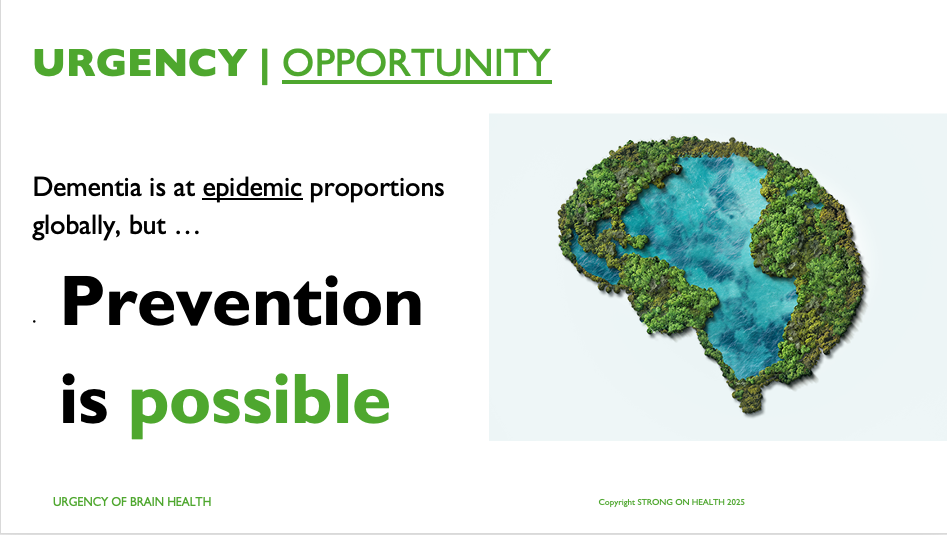
This year, I will be traveling across the country teaching an 8-hour clinical seminar:
“The Urgency of Brain Health”
This is not theory.
This is a deep dive into:
Practical, multi-modal protocols
Nutrition, lifestyle, and biomarker integration
Real-world strategies to support and restore brain function
Because this conversation needs to move beyond awareness…
And into implementation.
Looking Ahead: Brain Restoration Retreats (2027)
We are also preparing to launch something even more immersive:
Brain Restoration Retreats
Launching in 2027 at:
These retreats will be designed to:
Create a true neurological reset
Combine advanced diagnostics with experiential healing
Provide a structured environment for deep brain recovery
Because sometimes…
Healing requires stepping outside of your daily environment and fully committing to the process.
Final Thought: This Is About More Than One Nutrient
Omega-3s are not a magic bullet.
But they are a signal.
A signal that:
Brain health is measurable
Risk is modifiable
And prevention must start earlier than we think
The question is no longer:“Will this matter later?”
The question is:
Are we paying attention early enough to change the outcome?
Comments