


The Gold Standard Vaginal Ecosystem: What Every Woman Should Know
By Dustin Strong, CHN, ACN
Twenty years ago, practitioners were asking:
"Do you have an infection (need an anti-biotic)?"
Ten years ago, they were asking:
"What probiotic should you take?"
Today, the better question is:
"What ecosystem are we trying to create?"
That shift is profound.
For decades, women's health conversations have focused on identifying problems after they appear.
An infection. An abnormal Pap smear. Recurring symptoms. Fertility challenges. Hormonal changes.
But a growing body of research is teaching us something important:
Long before a condition develops, the ecosystem may already be changing.
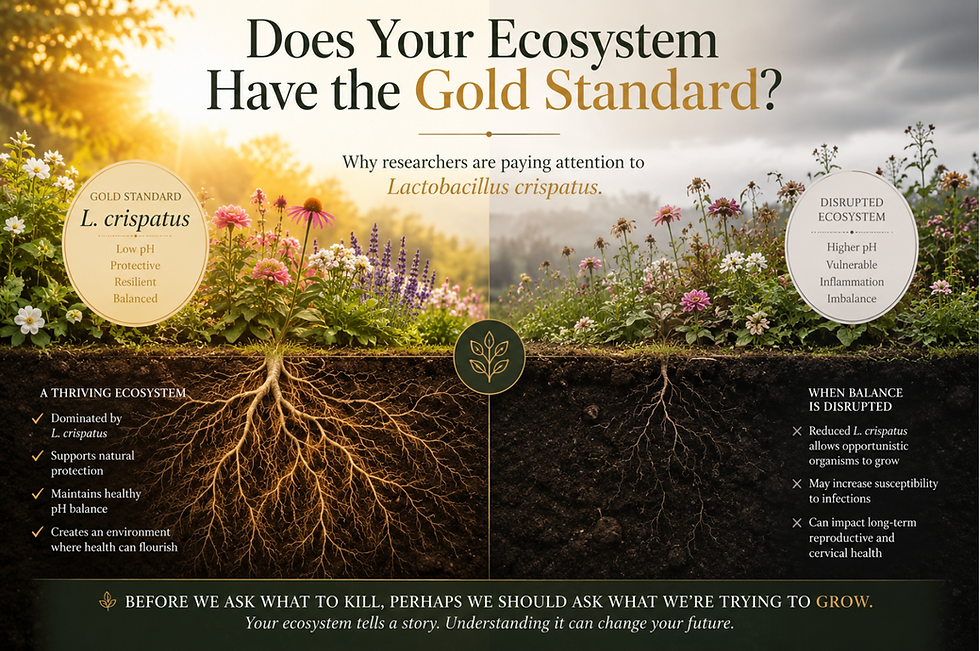
Just as a garden can tell us something about the health of the soil beneath it, the vaginal microbiome can tell us a great deal about the environment in which health either flourishes or struggles.
Among the thousands of organisms that can inhabit this ecosystem, one has attracted increasing attention from researchers around the world:
Lactobacillus crispatus.
In fact, many researchers now consider a Lactobacillus crispatus-dominant microbiome to be the "gold standard" vaginal ecosystem.
Why?
Because this remarkable organism appears to serve as one of the body's natural protective barriers.
L. crispatus helps maintain an acidic environment, produces compounds that discourage unwanted microbial growth, supports the integrity of the vaginal lining, and helps create conditions associated with resilience rather than vulnerability.
When levels are abundant, researchers generally observe a healthier microbial environment.
When levels decline, the story becomes much more interesting.
Studies have linked reduced levels of L. crispatus with increased susceptibility to bacterial vaginosis, recurrent infections, and disruptions of the normal vaginal microbiome.
More recently, researchers have begun investigating another fascinating possibility.
Women with lower levels of L. crispatus appear to have a higher susceptibility to certain sexually transmitted infections, including HPV, chlamydia, gonorrhea, and HIV.
To be clear, low L. crispatus does not cause these conditions.
However, it may weaken one of the body's natural lines of defense.
Perhaps even more intriguing are emerging studies examining persistent HPV infections.
Many HPV infections are naturally cleared by the immune system. Yet some persist for years, increasing the risk of future cervical changes.
Researchers are now finding that women with L. crispatus-dominant microbiomes appear more likely to clear HPV naturally, while women with disrupted microbial ecosystems may be more likely to experience persistent infections.
This may prove to be one of the most important women's health discoveries of the next decade.
Not because L. crispatus is a cure.
But because it reminds us that health is often built long before disease becomes visible.
As a nutritionist, this is precisely why I find this research so exciting.
Most people don't have a health problem as much as they have a timing problem in finding out these truths too late.
By the time symptoms appear, the ecosystem may have been changing for years.
The question is no longer simply whether a woman has an infection.
The better question is:
Does her ecosystem have the gold standard?
"Can't I Just Take an L. crispatus Probiotic?"
This is one of the first questions many women ask when they learn about L. crispatus.
The short answer is: maybe.
If researchers increasingly view L. crispatus as one of the hallmarks of a healthy vaginal ecosystem, it seems reasonable to wonder whether simply taking a probiotic containing this organism might be enough.
And in some cases, it may be helpful.
But there is an important distinction between making an educated guess and understanding your unique ecosystem.
A woman may have low levels of L. crispatus.
She may have healthy levels.
She may have other organisms competing for space.
She may have hormonal changes, antibiotic exposure, pH shifts, or environmental factors that make it difficult for beneficial organisms to establish themselves.
Simply adding a probiotic does not tell us which of these situations is present.
This is why I believe testing is so valuable.
For years, the question was:
"What probiotic should I take?"
Today, the better question may be:
"What does my ecosystem need?"
Taking an L. crispatus probiotic without testing is a little like planting seeds without first looking at the condition of the soil.
Sometimes the seeds grow beautifully.
Sometimes the soil needs attention first.
And sometimes the seeds were never the missing piece at all.
Why guess when we have the ability to measure?
In future articles, we'll explore how antibiotics, pregnancy, postpartum changes, hormone replacement therapy, and even probiotic use can influence this delicate ecosystem...and why understanding your microbiome may become one of the most valuable tools for protecting your future health.
Comments